March 18, 2026 · 7 min read
Your OpenAI Bill Doubled Last Month. Here's How to Find Out Why.
You opened your OpenAI dashboard and the number was twice what you expected. Maybe three times. You checked Anthropic next — same story. Your company is spending more on AI APIs every month, and nobody can tell you exactly why.
You're not alone. This is happening at nearly every company that moved LLM features into production in the last 12 months. The bill grows, but the breakdown doesn't exist. OpenAI gives you a monthly total. Anthropic gives you a usage chart. Neither tells you which team, which feature, or which customer is driving the spend.
The spreadsheet phase
Most teams start the same way: someone exports the monthly invoice, opens a spreadsheet, and tries to manually tag API calls to teams. Maybe they grep through logs looking for model names. Maybe they ask each team lead to estimate their usage.
This works for about one month. Then it breaks because:
- Multiple teams share the same API key. You can't attribute a call to a team if three teams use the same key.
- Models change mid-month. Someone switches from GPT-4 to GPT-4o halfway through the billing cycle. Your spreadsheet assumptions are wrong.
- Costs vary per request. A customer support chatbot and a document summarizer both use GPT-4o, but the summarizer sends 10x more tokens per call. Volume alone doesn't explain the bill.
- Nobody maintains the spreadsheet. The person who built it goes on vacation. The spreadsheet is two weeks stale by the time anyone looks at it again.
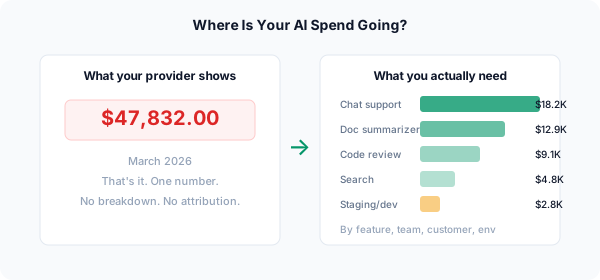
What you actually need: cost attribution at the API call level
The only way to reliably track AI costs by team is to tag every API call at the point where it happens — in the code, at request time. Not after the fact. Not from logs. Not from spreadsheets.
Here's what that looks like in practice:
Every LLM request should carry:
- Feature — which product feature triggered this call (e.g., "chat-support", "doc-summarizer")
- Team — which engineering team owns this code path
- Customer ID — if the call is on behalf of a specific customer
- Environment — production, staging, or development
With these four dimensions tagged on every request, you can answer any question finance or leadership throws at you:
- "How much did the product team spend on GPT-4o last month?"
- "What's the AI cost per customer for our enterprise tier?"
- "How much are we spending on staging vs. production?"
- "Which feature is growing the fastest in cost?"
The three approaches to implementing this
1. Build it yourself. Wrap every LLM call with logging that captures model, tokens, and your tag dimensions. Write the data to a database. Build dashboards. Maintain the pricing table as providers change rates. This works, but it's a multi-sprint project that nobody wants to own long-term.
2. Use your cloud provider's tooling. AWS Cost Explorer, GCP Billing, Azure Cost Management — none of them understand LLM token-level costs. They see EC2 instances and Lambda invocations, not GPT-4o prompt tokens. This is a dead end for API-based AI spend.
3. Use a purpose-built AI cost governance tool. A control layer that attributes every dollar of AI spend to the team, project, customer, and cost center that owns it, in real time — and lets you set thresholds, route approvals, and apply controls before the bill arrives. No spreadsheets. No log parsing. No maintenance burden.
The math that matters
Here's why this is urgent, not just important: AI API costs compound differently than cloud infrastructure costs.
With cloud, you provision a server and the cost is predictable. With AI APIs, every user interaction generates a variable cost. More users, more tokens, more money — and the relationship isn't linear. A single poorly designed prompt template can cost 5-10x more than an optimized one, and you won't know until you measure it.
Companies spending $20K/month on AI APIs today are projecting $100K+ within 12 months as they roll out more AI features. Without attribution, that growth is invisible until the invoice arrives.
Start before the next bill
The best time to instrument your AI spend was when you first deployed to production. The second best time is before your next monthly invoice. Tag your calls, break down the numbers, and give your finance team something they can actually work with.
The companies that get ahead of this now will have 12 months of cost data by the time their competitors are still arguing over spreadsheets.
This is what we built CapHound for.
CapHound gives FinOps teams real-time AI cost attribution across OpenAI, Anthropic, and Google — by feature, team, customer, and environment. No spreadsheets, no log parsing.