March 18, 2026 · 6 min read
AI Cost Management Is the Next FinOps Problem — And Nobody's Ready
In 2015, the average enterprise had one cloud provider and a single billing dashboard. FinOps didn't exist as a discipline yet. Companies were getting surprise AWS bills, and the only answer was "hire someone to look at Cost Explorer."
That problem spawned an entire industry — FinOps tools, dedicated teams, a professional foundation, and certifications. It took about eight years for cloud cost management to mature into a real practice.
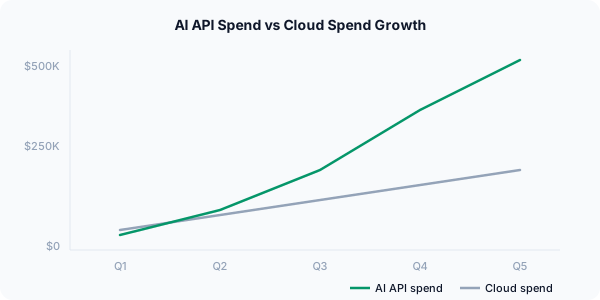
AI API spend is now following the same curve. Except it's moving 10x faster, and the tooling gap is wider.
Cloud costs (2015)
Growing 20-30% year over year
AI API costs (2026)
Growing 200-400% year over year
Cloud billing tools
AWS Cost Explorer, GCP Billing, Azure Cost Management
AI billing tools
A monthly total on a settings page
Why AI costs are harder to manage
Cloud infrastructure costs are mostly predictable. You provision an EC2 instance, you know what it costs per hour. You can right-size, reserve capacity, and forecast with reasonable accuracy.
AI API costs break every one of those assumptions:
- Costs are per-request and variable. Every API call costs a different amount depending on prompt length, completion length, and model choice. There's no "right-sizing" equivalent.
- Multiple providers are the norm. Most production systems use OpenAI for some tasks, Anthropic for others, maybe Gemini for specific use cases. Each has different pricing models, different token definitions, different billing cycles.
- Costs are embedded in application code. Cloud costs are tied to infrastructure. AI costs are tied to features. Every new AI feature is a new line item that doesn't show up in any infrastructure dashboard.
- Usage scales with customers, not infrastructure. When your customer base doubles, your AI API costs can more than double — because each customer interaction generates token spend. This is fundamentally different from cloud, where you scale servers to handle traffic.
What FinOps teams are hearing from leadership
If you're in FinOps right now, you've probably been asked some version of these questions in the last 90 days:
"How much are we spending on AI?"
"Which teams are driving the most AI cost?"
"Can we set budgets per team or per feature?"
"What's our AI cost per customer?"
"Are we using the right models, or are we overpaying?"
These are the same questions FinOps teams learned to answer for cloud spend. But the tools that answer them for cloud — Cost Explorer, Cloudhealth, Kubecost — have no concept of LLM tokens, prompt costs, or model-level attribution.
The four capabilities FinOps teams need for AI
1. Real-time cost visibility
Not a monthly invoice. A live dashboard showing spend by model, provider, team, feature, and customer — updated as requests happen.
2. Budget alerts and enforcement
The ability to set spend thresholds per team or feature, with automatic alerts before budgets are exceeded — not after.
3. Chargeback and cost allocation
Reports that assign AI costs to business units for internal billing. The same thing FinOps teams already do for cloud — but for LLM spend.
4. Model and provider optimization
Data-driven insight into whether you're using the right model for each task. GPT-4o might be overkill for a classification task that GPT-4o-mini handles at 1/10th the cost.
This is a new discipline
Cloud FinOps matured because dedicated people built practices, tools, and frameworks around a problem that wasn't going away. AI cost management is at the same inflection point.
The companies that build cost visibility now — while spend is still manageable — will be the ones making informed decisions when AI budgets are 10x what they are today. The ones that wait will be back in the spreadsheet era, trying to reverse-engineer a $500K monthly bill with no attribution data.
The good news: the FinOps principles you already know — visibility, allocation, optimization — apply directly. The tooling just needs to catch up.
CapHound brings FinOps to AI spend.
Real-time cost attribution across OpenAI, Anthropic, and Google. Budget alerts, chargeback reports, and governance — built specifically for FinOps teams managing AI API costs.